




If you want to grow your assets sensibly and over the long term, a fund-based savings plan is a simple way to invest money – it’s worthwhile not only for younger investors, but also for people with life experience and financial stability.
Why investing is more worthwhile than ever
Interest rates on traditional savings accounts continue to plummet, while inflation is eating up savings. So if you only save, you lose purchasing power in the long term. The alternative? Invest. You can only get more out of your money by investing it. This can be done, for example, with a lump-sum investment, but also with regular, targeted investments with a fund-based savings plan. This offers two ways to benefit: the compounding effect and the cost averaging effect.
What is a fund-based savings plan?
A fund-based savings plan is basically an automated form of investment: each month (or quarter), a fixed amount is paid into one or more investment funds. This can be an equity fund, a mixed fund or even a sustainable fund – depending on your risk appetite and investment objective. This is possible even from small sums, which can then grow into substantial assets over a period of time.
Because smart decisions start with a conversation
Would you like to know how a fund-based savings plan fits into your life plan? Let’s take a look at your options together – in a non-binding, free initial consultation.
The cost averaging effect: clever use of fluctuations
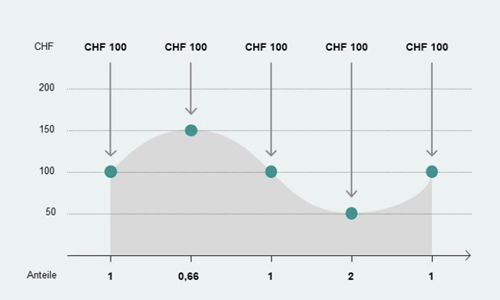
A major advantage of regular deposits is the cost averaging effect. This can help to spread the risk, especially in volatile markets. After all, if you invest regularly instead of investing a large amount at once, you buy more fund units when prices are low and correspondingly fewer when prices are high. This can result in a favourable average price over time. This protects against expensive mistakes at times when prices are high and reduces the risk of entering at the wrong time.
The compounding effect: looks like magic, but is simply explained
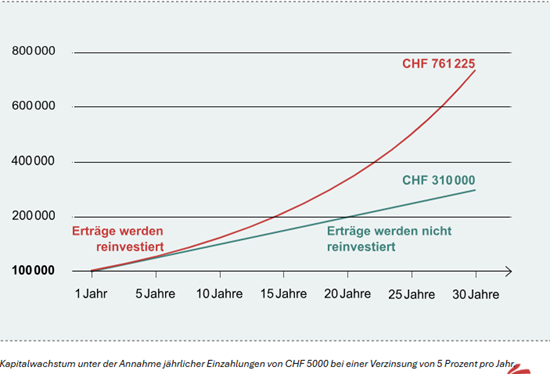
Making disproportionately more out of your own money without having to do much – sounds good, doesn’t it? That’s exactly what the compounding effect can do. It works easier than you may think– because the compounding effect basically means that interest and net capital gains on the invested amounts are not paid out, but are automatically reinvested again and again, thus generating returns. This is how a fund-based savings plan grows like a snowball rolling: the earlier you start and the longer you stay invested, the greater the effect.
Calculate your return now
Calculate in just a few clicks how the value of your investment will develop.
A fund-based savings plan is particularly worthwhile in these life situations
1. Providing for children or grandchildren
Those who have already achieved a lot in their own lives often want to give something to the next generation – not just values, but also financial security. A fund-based savings plan is a particularly effective tool here. Even with small monthly amounts you can accumulate solid starting capital over 15 or 20 years. Whether you are studying, studying abroad or buying your first home: if you start early, you will benefit from the compounding effect and the long investment period.
2. Realise a lifelong dream faster
A trip around the world, renovating your home, owning your own horse – what do you dream of? With a well-thought-out investment, the goal is usually within reach more quickly than with traditional savings. With the fund-based savings plan you can achieve great things with small amounts and flexibly adjust your monthly savings amount with most providers or, if necessary, pause it. And when the time comes, your capital will be available to you – exactly when you need it.
Tip: If you want to invest a larger amount of money, you should consider “target-based investing” – and invest your money in a way that best suits the way you live. Our free information sheet provides you with further information on why “Target-based investing” is a secure, efficient and effective investment strategy.
3. Invest larger amounts in stages
Many people have “parked” some of their assets in the second half of their lives – whether from inheritances, savings or a payout from an insurance policy. This capital is often deposited in an account without interest. Depending on the amount of the capital, it may be worth investing it regularly instead of making a lump-sum investment. In this way, you can minimise the risk of entering at the wrong entry point – when prices are high. In this way, you can minimise the risk of entering at the wrong entry point – when prices are high.
Invest with strategy and serenity
A fund-based savings plan is not a hectic ride on the stock market but a long-term concept for people who want to act with foresight. Whether for yourself, your children or grandchildren – regular investing brings structure to asset management and at the same time creates flexibility. If you familiarise yourself with the basics, you can set your money in motion – calmly, in a well-planned manner and with the prospect of more. And: people who are not so familiar with the subject of investing money will find the fund-based savings plan a simple way to get started. After all, it works as simply as a standing order, and the risk of investing at the wrong time is very low – a fund-based savings plan in a broad-based fund is also suitable for anyone who only wants to take on little risk but would like to make more out of their money.
Tip: Good advice helps you find the right fund selection and investment strategy. After all, investing can be as individual as life.

Tobias Kipfer
Financial Consultant & Relationship Manager
Tobias Kipfer ist Financial Consultant & Relationship Manager mit Fokus auf langfristigen Finanzplanungen und individuellen Vermögensverwaltungen bei Swiss Life Wealth Managers in Winterthur. Nach seinem Bachelorabschluss in Betriebswirtschaftslehre an der HSG St. Gallen absolvierte er ein Praktikum im Financial Consulting und Wealth Management und bildete sich zum Finanzexperten weiter.