



Rational decisions are particularly important for investment success – and particularly difficult. Our psychological tips will help you outwit your head and make smart investment decisions.
Financial decisions depend heavily on personal expectations and very unconscious behaviour patterns – which is precisely why there are some pitfalls investors can fall into. However, if you know the psychological pitfalls of investing, you can not only invest more consciously, but also more successfully.
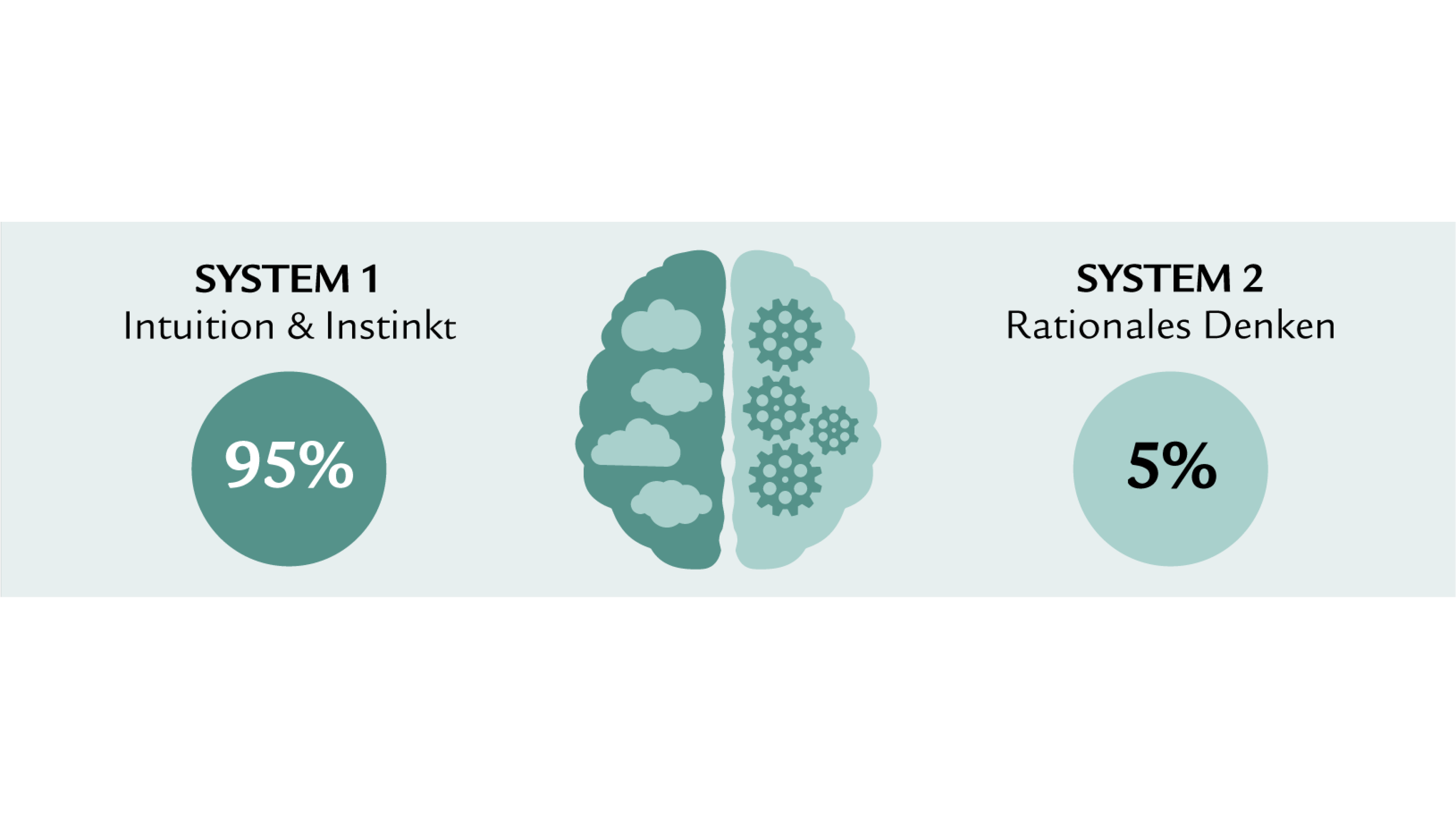
95% of our decisions are based on instinct and intuition – this is the only way to manage the plethora of unconscious decisions we make every day. But when it comes to investing, the second system, rational thinking, must take precedence over the fast, intuitive first system.
1. Fear of loss: Why we perceive losses more than profits
Profits are good, losses are bad – that’s how our brains think. When it comes to investments, the focus of our psyche often shifts to avoiding losses rather than making profits. Investors remain invested in hopeless investments in order not to have to realise their loss, which is only on paper for the time being. If you don’t want to fall into the loss aversion trap, you should consider rationally and analytically, possibly with the help of experts, whether it’s worth selling investments and, in the worst-case scenario, realising a smaller loss, instead of staying invested as a matter of principle and getting annoyed about an even larger loss later.
2. Overestimation: The Dunning-Kruger effect when investing
People tend to overestimate their abilities – including when it comes to finances. Investors who are convinced by their investment strategy and believe that they can assess price trends better than others not only feel superior; they often miss out on potential returns or incur avoidable losses. This is because they rely more on individual equities with which they are supposed to be particularly familiar rather than broadly diversifying, or they trust their own information and gut feeling more than expert opinions.
Tip: You can counteract the Dunning-Kruger effect particularly well by working out your investment strategy with an expert and receiving individual advice. This way you can avoid the risk of misjudging your own financial knowledge, always obtain a second opinion and do not have to embark on the path to a financially self-determined life alone.
3. Attraction of topicality: when new information drives decisions
Stories about fast money with cryptocurrencies, the regret of not having invested in a specific equity in time, or a news article about the fact that equity markets will soon fall – newer information is quickly retrieved and heavily weighted in the brain, influencing investment decisions more strongly than long-established information. This cognitive bias also leads to decisions being less rational, more emotional and news-driven, which is extremely bad advice, especially when making long-term investment decisions.
Expert knowledge instead of hearsay
Our financial experts provide you with comprehensive and in-depth advice on the issues that are important to you concerning your assets – without any cognitive bias.
4. Confirmation error: how we like to prove ourselves right
Being right feels good, doesn’t it? It is precisely then that confirmation bias strikes, with information that confirms our own assumptions and opinions outweighing information that contradicts us. For example, those who are convinced of the potential of a particular equity tend to filter out only those pieces of financial news that support their view. It’s a good idea to obtain in-depth information that is as balanced as possible before making investment decisions.
5. Herd instinct: why trends are not always the best investment idea
The sure-fire tip at the pub, the newspaper article about a particularly attractive investment, new global trends such as artificial intelligence – if everyone else does it, it can’t be wrong, is the motto of many investors. However, for long-term investment success, it is much more promising to follow an individual investment strategy than always opting for trendy (and often expensive) investments. After all, particularly popular investments are often particularly expensive and quickly plummet again after the hype. Trends come and go, but your own assets should remain and grow – the mistake of always jumping on the bandwagon can also be easily avoided with comprehensive advice.
Tip: Do you want to invest even more rationally? In our blog we show you the three biggest pitfalls lying in wait for investors – and how you can avoid them.
Increased potential returns through rational thinking and expert knowledge
Not letting your own brain outwit you is easier said than done, especially when your friends’ investment tips or the prospect of a quick profit (or a small loss) sound so tempting. If you don’t want to fall into psychological traps when investing, you should always be aware of the cognitive distortions that may lurk when investing and seek the help of experienced advisors. You can then make more rational decisions in future, which not only feel better, but ideally also lead to higher potential returns.
Tip: in our interview, Prof Anne Herrmann, Professor of Business Psychology and Head of the Institute at the University of Applied Psychology FHNW, provides interesting insights into different types of money and explains how our attitude to money shapes our lives.
Self-test: Are you falling into psychological traps?
Answer the following questions honestly with yes or no:
- Do you hold on to investments even though you know they are performing badly – because selling them looks like a loss?
- Do you feel that you know more about finance than most people?
- Do you often make investment decisions spontaneously based on the latest news or trends?
- Do you look specifically for information to confirm your opinion on an investment?
- Have you ever invested in a product just because “everyone else” has done it too?
- Do you feel unsure about your financial future?
- Is it easier for you to spend money on short-term wishes than on long-term goals?
- Do you avoid taking an active part in your finances even though you know it would be important?
- Do you often trust your gut feeling more than in-depth analyses or expert opinions?
- Do you not have a clearly defined investment strategy that fits your long-term objectives?
How to evaluate the self-test:
- 0–2 x Yes: You already think quite rationally – remain vigilant.
- 3–5 x Yes: Some mistakes in thinking could slow down your returns – a financial check is worthwhile.
- 6+ x Yes: It’s high time you reassessed your investment strategy with professional help.
A free initial consultation with our financial advisors will help you in any case – whether you want to draw up your investment strategy in a rational and target-based manner or to further optimise your current strategy and make even more out of your money.

Asdren Suli
Financial Consultant & Relationship Manager
Asdren Suli is a Financial Consultant & Relationship Manager at Swiss Life Wealth Managers in Zurich and specialises in financial planning and individual asset management. He uses his in-depth knowledge and skills to develop customised financial solutions for his clients. His expertise spans various areas of the financial world, with a focus on long-term financial strategies that meet the individual needs and goals of his clients. Thanks to his many years of practical experience and specific training as a qualified business economist HF and federally certified financial planner, he has a profound understanding of economic interrelationships and the complex challenges of financial planning.