
Companies that actively support the wellbeing of their employees are making a sustainable investment in long-term success. Swiss Life highlights the most effective measures and targets in occupational health management and shows how to implement them in a structured, seamless way. The result? A system that safeguards wellbeing and performance over the long term, while providing targeted support for employees returning to work after a prolonged illness.
What isoccupational health management (OHM)?
Every company has its own definition of success. In all cases, however, the employees are crucial, so the question of employee wellbeing and how employers promote it is essential.
Occupational health management helps employers to create a healthy atmosphere and establish it as an integral part of the corporate culture. OHM is intended to create conditions in which employees can remain healthy, realise their potential and perform well over the long term.
Three central OHM areas and the related measures

Prevention
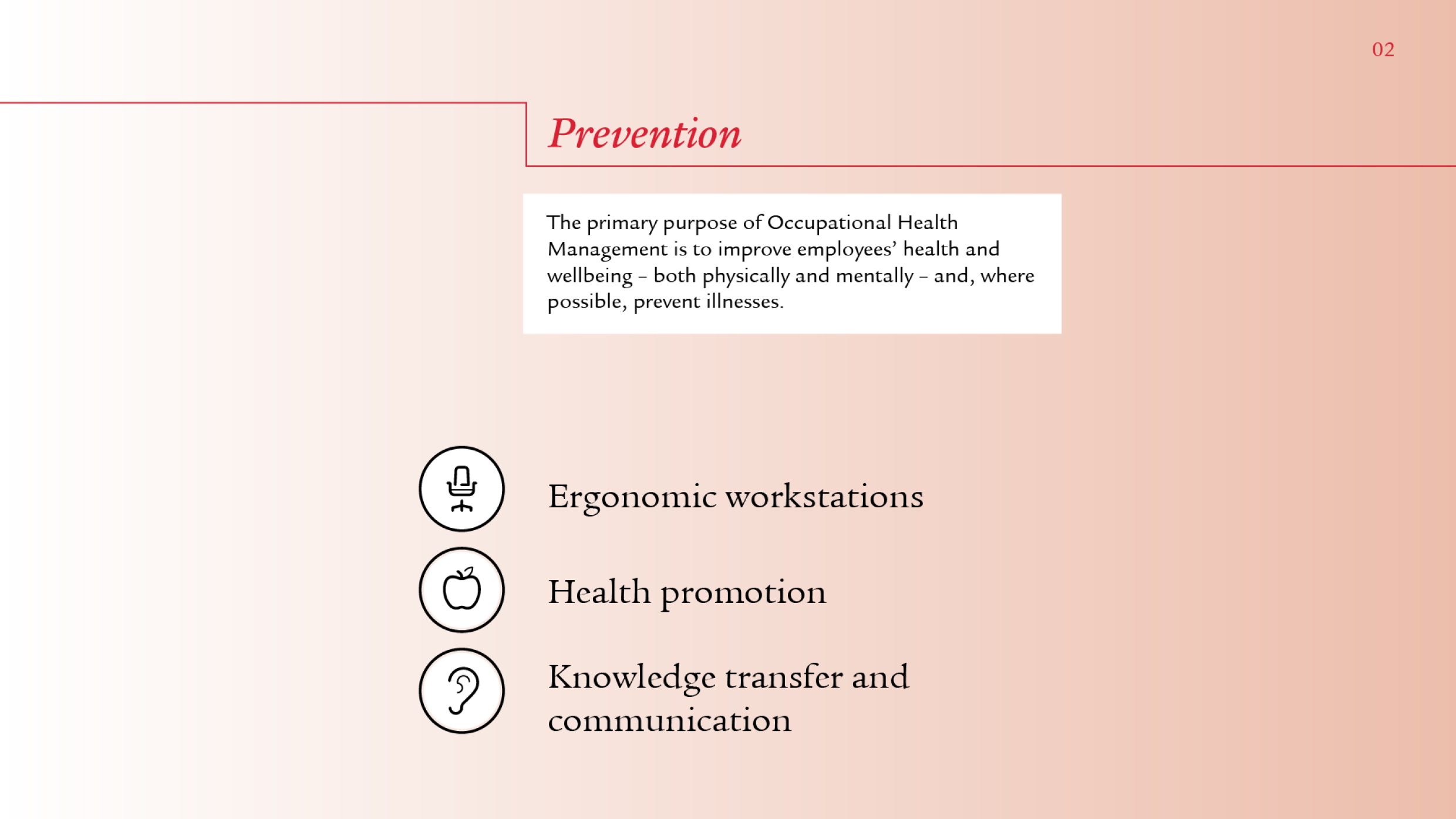
OHM focuses on improving employees’ health and wellbeing and preventing ill health and injury wherever possible. Employers can introduce measures to this end in the company and at individual workstations. Prevention includes raising employees’ awareness around key OHM topics and actively involving them in the process.
Examples of prevention through OHM:
- Ergonomic workstations: Height-adjustable desks and ergonomic chairs can reduce back pain.
- Health promotion: Targeted breaks, exercise programmes and anti-stress workshops. “Soft factors” such as respect, trust and appreciation are also vital for employees’ wellbeing.
- Knowledge transfer and communication: Inform employees and regularly raise their awareness on key topics such as sleep, mental wellbeing and rest. This can also include further training, for example in the form of team workshops, independent study and presentations.
Early intervention
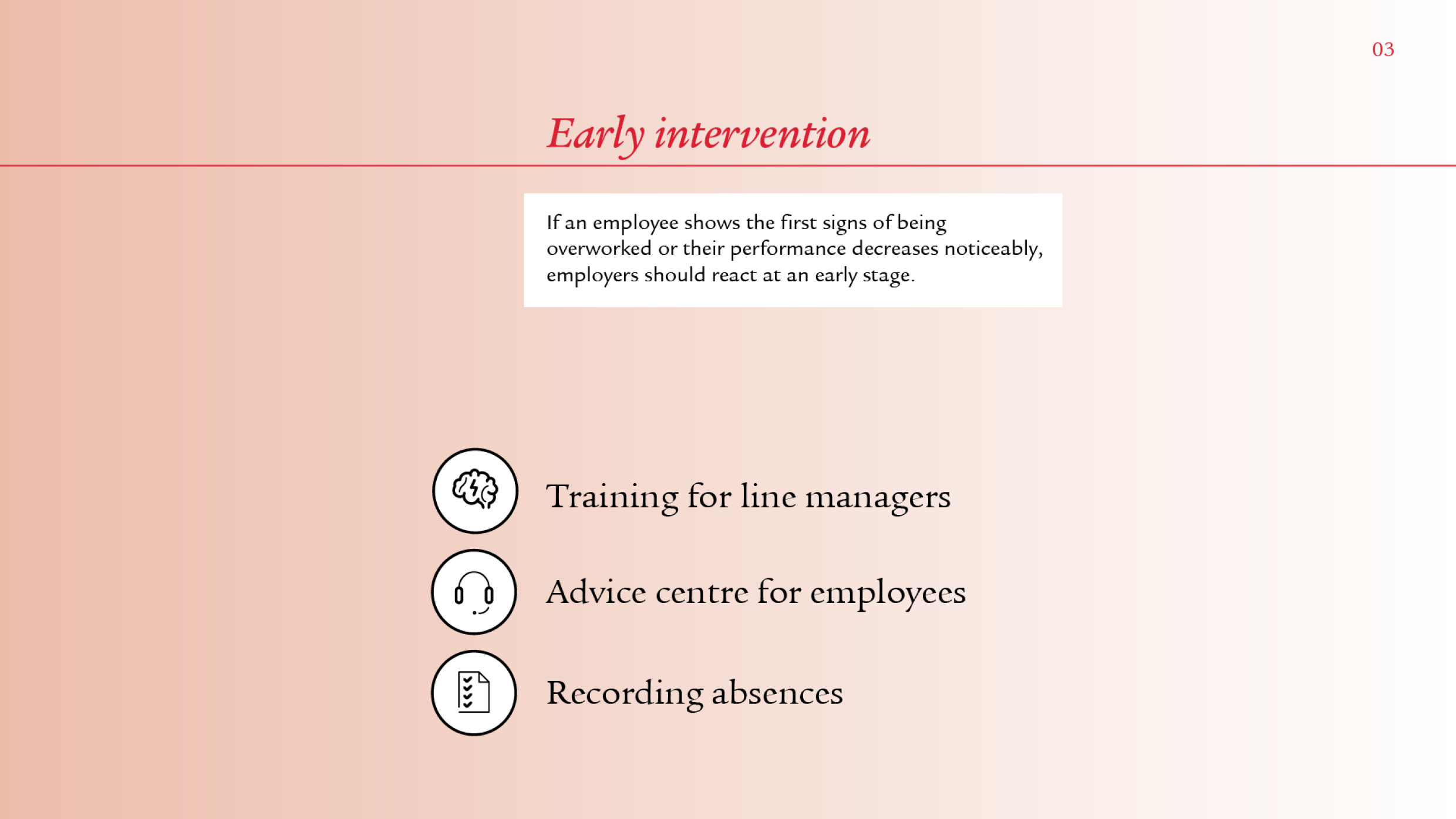
If an employee shows the first signs of being overworked or their performance decreases noticeably, employers should react at an early stage. This may be the case, for example, if high workloads, stress or conflicts become apparent in the team. Exhaustion and decreased performance often lead to employee absences. The sooner you identify such cases, the better you will be able to support affected employees and teams.
Examples of early intervention through OHM:
- Training for managers: Managers can learn to recognise and address the first warning signs of overwork or exhaustion and plan appropriate steps together with employees.
- Advisory service for employees: Employees have a confidential internal or external contact person who can help them with stress, excessive workload and conflicts.
- Recording absences: By systematically recording and analysing absences, companies can identify anomalies at an early stage and provide suitable support services.
Reintegration
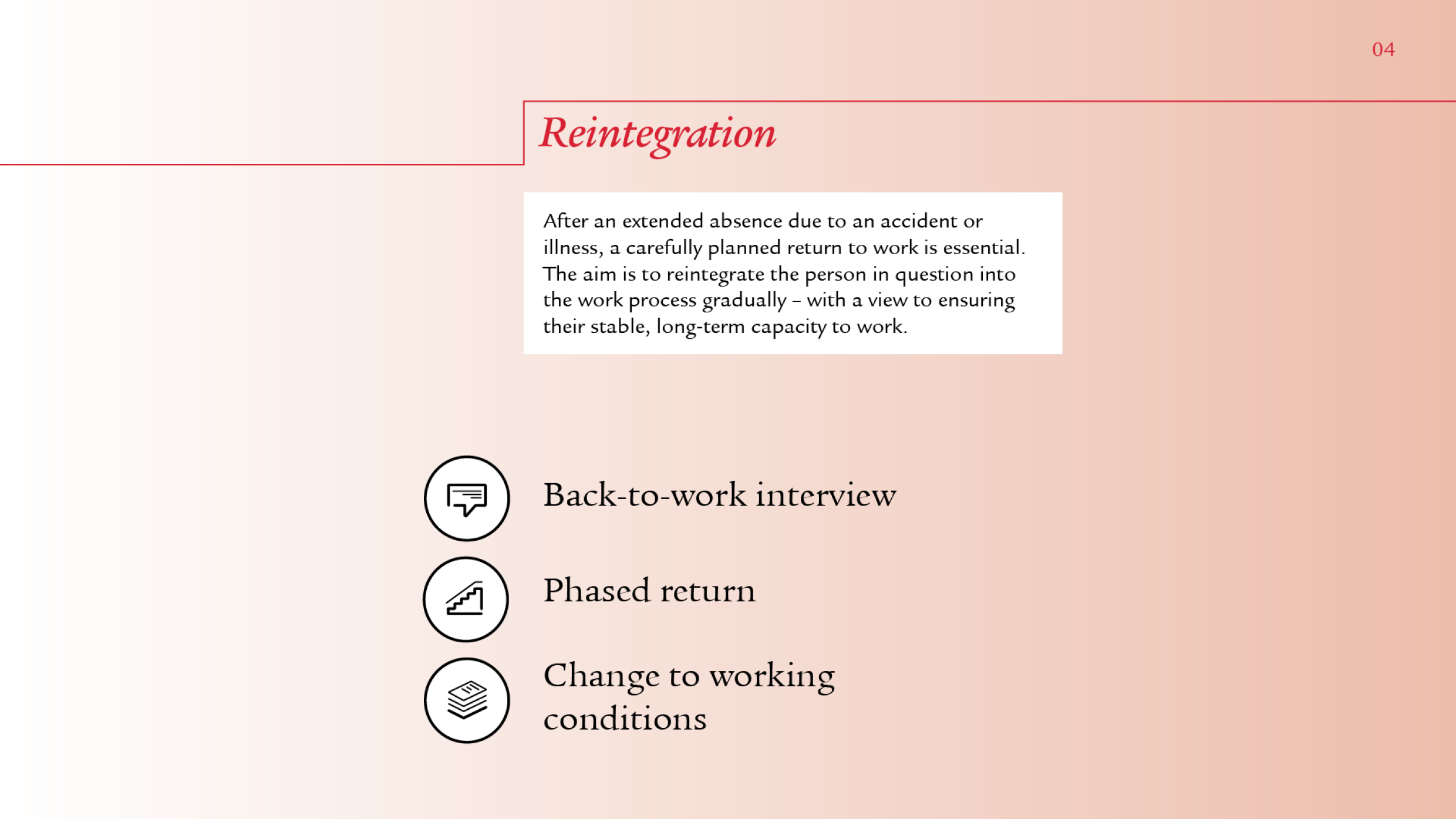
After an extended absence due to an accident or illness, a carefully planned return to work is essential. The aim is to reintegrate the person in question into the work process gradually – with a view to ensuring their stable, long-term capacity to work. It is important to plan the return to work with the employee, taking into account individual capabilities and limitations.
Examples of reintegration through OHM:
- Back-to-work interview: Even in the case of shorter absences, it may make sense to hold a back-to-work meeting with the employee in order to update them and ask about their health. After an extended absence, it is important to have a structured discussion in order to clarify the need for support.
- Phased return: After a prolonged absence, it can be helpful to organise a phased return to work. This can be done, for example, by reducing the employee’s level of employment and adapting their responsibilities.
- Adapt working conditions: Temporary adjustments – such as giving the employee different responsibilities or changing their area of work – can help to reduce stress and stabilise the employee’s ability to work over the long term.
“If you use these three key areas as the basis for occupational health management measures in your company, you’re on the right track,” says Snezana Milojevic, Head of OHM at Swiss Life. “After OHM measures have been introduced, it is important not to neglect them, especially in stressful periods with high workloads. In the end, the company will also benefit by retaining employees and their expertise.”
In addition, OHM should be viewed and practised holistically:

Did you know? The law regulates some areas ofhealth management
Swiss companies are legally obliged to protect the physical and mental health of their employees at work and to take preventive measures. Employees also have a say in matters involving occupational safety and health protection. Relevant articles can be found in the Swiss Code of Obligations (Art. 328) and the Employment Act (Art. 6).
Minimising risks with OHM
Effective OHM measures enable companies to reduce the risk of long-term health absences and disability. This can have a positive impact on insurance premiums for daily sickness benefit and accident insurance as well as occupational pensions. At the same time, you will increase your company’s attractiveness as an employer to current and future employees.
Why is OHM particularly important for SMEs?
In small companies, it is often more difficult to organise spontaneous deputisation, which might be required in the event of illness. This puts more pressure on the other employees, increasing their workload and stress levels. One possible consequence is a phenomenon called presenteeism. This is when staff come to work even though they are ill and should be recovering. Although they are physically present, their ability to work is limited. According to a study by the Bern University of Applied Sciences, around half of those surveyed said they had gone to work despite being ill the past 12 months – i.e. they practised presenteeism (source: BFH).
In larger companies, employees in specialised roles – for example in the HR or OHM team – often take on the systematic planning and implementation of OHM measures. Most smaller firms do not have these resources. However, they can bring in external specialists who provide targeted support to managers and HR and enable them to take health issues into account in their day-to-day work.
By organising workshops and seminars and giving tailored advice on OHM, Swiss Life helps corporate clients to establish OHM effectively and practically in their day-to-day work.
How to introduce OHM at your company
Analyse the current situation
First, determine the current state of occupational health management at your company. Even if you have not yet introduced a formal OHM system, some individual elements are usually in place already – such as prevention, occupational health and safety or personnel development measures. An expert can help you to assess your current situation and give recommendations on which topics you should focus on. An assessment of this kind by the Swiss Life expert team is free of charge for Swiss Life corporate clients.
OHM goals and measures
Based on the initial analysis, you can then define specific OHM goals for your company. You will achieve the greatest benefit if these objectives are aligned with your corporate strategy. In this way, OHM measures can specifically help with overarching objectives such as increased customer satisfaction and employer attractiveness, healthy productivity or lower staff turnover.
Introduction and communication
Inform your employees transparently and comprehensibly that you are introducing occupational health management and explain the specific benefits that this will have for them personally and the company. Managers play a key role here – they should receive support from trained internal or external specialists if necessary.
Analyse and improve OHM
An important step in addition to the consistent implementation of OHM measures is regular analysis. Check whether your team is achieving its targets and adjust your measures if needed. Clearly defined metrics are helpful for making the development and impact of your OHM activities visible. In this way, occupational health management is continuously adapted to the needs of your company and your employees. OHM remains a living concept, rather than coming to an end after a one-off initiative.
FAQs
Occupational health management comprises three key areas: prevention, early intervention and reintegration. Prevention improves employees’ health and wellbeing and helps to stop illnesses from occurring in the first place. Early intervention starts when the first red flags or signs of stress become apparent. Reintegration helps employees to return to work gradually and sustainably following an accident or prolonged illness. Together, these activities help to ensure employees’ ability to work and perform to a high standard over the long term.
The costs of setting up an OHM system depend to a large extent on the company’s initial situation and objectives. Relevant considerations are, for example, internal resources (time spent by HR, line managers and project managers), external consulting and training. For Swiss Life corporate clients, OHM advice is already included in the pension solution in many cases and is thus free ofcharge.
At the same time, it is worth taking a look at the impact. Stress-related productivity losses cost the Swiss economy around CHF 6.5 billion annually (2022 Job Stress Index, Gesundheitsförderung Schweiz) – professional OHM can help to reduce such losses and promote healthy productivity.
Formal OHM is not prescribed by law in Switzerland, unlike certain types of insurance. However, it is a legal requirement for companies to protect their employees’ physical and psychological health and take appropriate preventive measures (e.g. Art. 328 of the Swiss Code of Obligations and Art. 6 of the Employment Act). Structured OHM helps to systematically implement these legal obligations and to establish employee wellbeing and performance as an integral part of the corporate culture.
Small companies can also set up effective OHM systems – they do not necessarily need a separate HR or OHM department. It is often enough to have one person responsible for coordinating the activities, defining the initial priorities (e.g. management or mental health) and implementing simple, appropriate measures. In addition, smaller companies can bring in external specialists to advise and support their management board, line managers and employees on OHM matters. They might assist with assessing the current situation, planning measures or raising awareness in teams, for example.
OHM measures range from healthy workplace design (ergonomic workstations), awareness-raising and early detection of imminent absences to reintegration programmes after prolonged illnesses. It is important for every company to derive its measures from an assessment of its current situation and its own goals – ideally in line with the corporate strategy. This results in OHM that clearly benefits employees and the company alike.
For OHM to remain effective, companies should define clear, measurable goals, e.g. in the area of wellbeing, capacity for work and leadership culture. Success can be monitored through various metrics and feedback, such as health and employee surveys, staff turnover rates, selected absence data, feedback from teams and participation rates in services. A comparison of actual and target values will show which measures are working and where changes are needed.
Insurance companies can support businesses with OHM on several levels. They provide expertise, analyses and advice, help to assess risks and frequently offerspecific prevention, health promotion and reintegration services.
Well-established OHM can help to minimise health risks and thus reduce the risk of long-term benefit claims. In the long run, this has a positive impact on the stability of cost and premium structures.