




Invest money without taking a risk? That’s hardly possible – but risk can be minimised. This includes a long-term investment horizon, diversification, rational investments and avoiding avoidable investment errors. Because they cost up to 6.5% in returns per year.
Daily deposits, time deposits, savings accounts – these classic types of investments are considered particularly secure. But they have one major disadvantage: the return is often below the rate of inflation. This means that the money loses in real value over time. If you park your capital supposedly “securely,” you run a different risk: loss of purchasing power.
Investing money without risk is therefore often a question of perspective. Instead of relying solely on absolute security, it is important to deal with risks intelligently. This is where strategic investing begins.
Investment errors cost a lot of money – and can be avoided
Numerous scientific studies show: many individual investors act emotionally rather than rationally. They buy and sell at the wrong time, do not diversify their portfolios enough or allow themselves to be guided by chance when selecting securities – for example through media reports or personal preferences. These behaviour patterns cost not only nerves, but also your returns.
For example, the renowned Zurich behavioural economist Prof. Thorsten Hens has shown in an analysis that behavioural investment errors can lead to a drop in returns of up to 6.5% per year. In the long term, the compounding effect increases these losses dramatically. So it is often not the markets that pose the greatest risk when investing – but rather a person's own behaviour.
The good news is that many of these mistakes can be avoided – through more structure, knowledge and support from specialists.
Tip: in this blog article, we explain how you can avoid falling into the three biggest investment traps.
Loss of returns due to behavioural investment errors
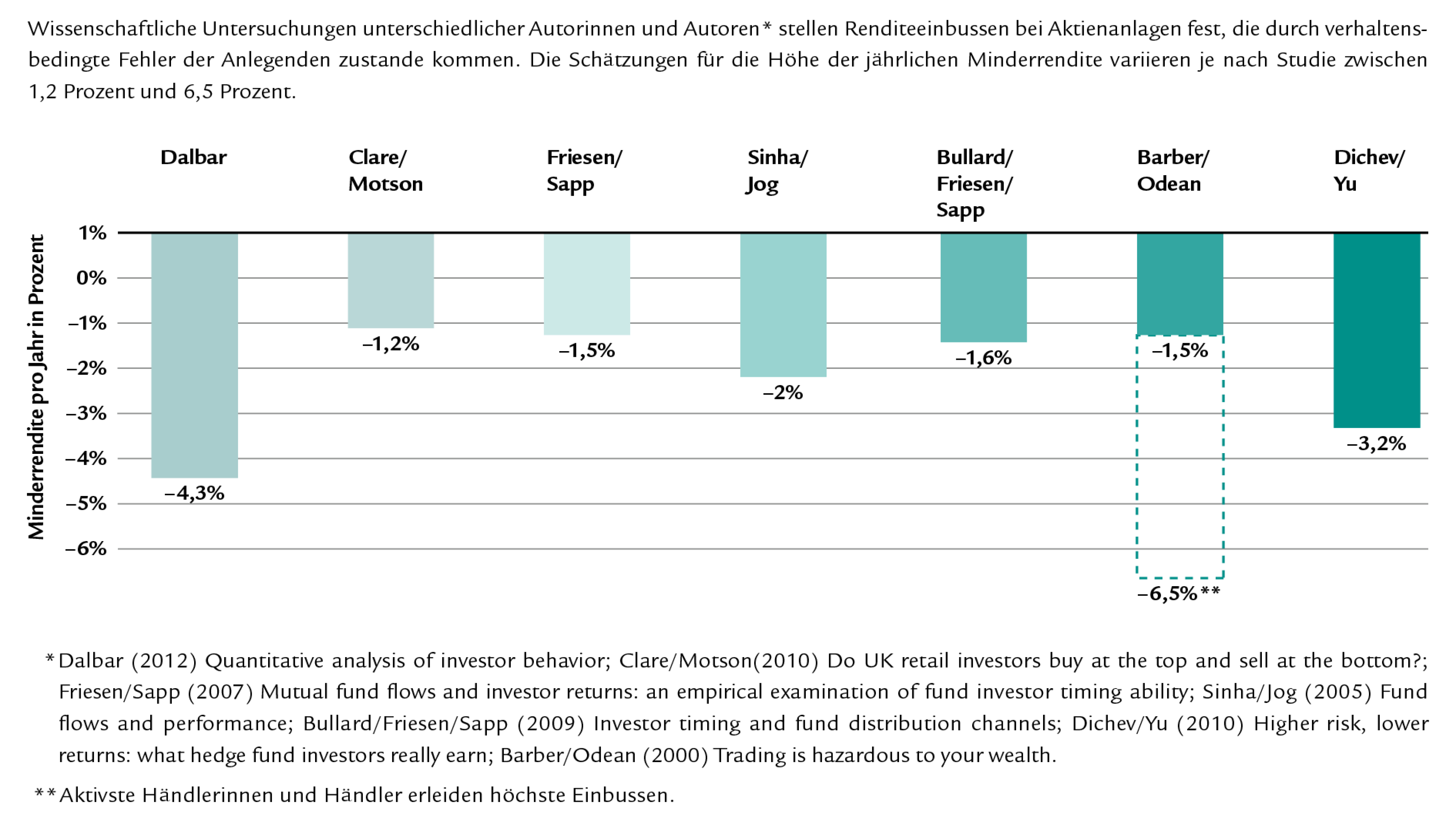
Source: Professor Dr. Thorsten Hens / Behavioral Finance Solutions
Why exactly the investors who can benefit the most don’t
Particularly paradoxical: those who could benefit most from professional investment advice often forego it. A study by Thorsten Hens and Kremena Bachmann shows: people with little investment expertise are less likely to seek advice. Conversely, more competent investors are more willing to delegate their investment decisions – although they would theoretically not have to do so due to their expertise.
That's because investors in particular often overestimate their own abilities. They attribute positive experiences to their own abilities and ignore external factors, such as a general boom phase or simply luck. You can learn more about this phenomenon called the Dunning-Kruger effect and other psychological investment tricks in this blog.
The researchers could not find any significant correlation between perceived and actual competence. In short: those who think they know a lot are often mistaken – with corresponding consequences for their investments.
Good advice is a wise decision – especially in old age
The researchers also found that the demand for financial advice increases with age and with a larger investment volume. According to the study, investors with larger assets are also more likely to delegate decisions or involve several specialists. However, gender, education, professional independence or income have no influence on the willingness to seek advice.
Speaking of age: People who decide for themselves are often younger, less affluent, consider themselves to be more experienced, have less investment expertise and rely more on their own judgement rather than on expert assessments. Those who delegated investment decisions, on the other hand, often have greater investment expertise and rely less on their own judgement and more on that of professionals.
“The investor’s chief problem is not the bank, which charges excessively high fees, but the investor himself,” said Benjamin Graham, an economist and teacher of the investment legend Warren Buffett. Graham’s assessment is supported by behavioural economics. Investment advice costs. However, professional advice can help investors avoid mistakes – and can thus also prevent them from losing money or taking unnecessary risks as a result of their own investment mistakes.
Expert knowledge instead of hearsay
Our financial experts provide you with comprehensive and in-depth advice on the issues that are important to you concerning your assets – without any cognitive bias.
Investing money without risk – a myth?
Money can never be invested completely without risk – risk-free returns are therefore a myth. But risk does not automatically mean a loss. If you understand risks and manage them strategically, you can even use them to your own advantage. This is where the strength of professional financial advice comes in: it helps not to avoid risks, but to classify them with a view to personal life goals and to make meaningful use of them. For example, by:
- Broad diversification, i.e. diversification across different asset classes, regions and sectors
- Investment strategies that suit your risk profile and life goals
- Long-term rather than short-term reaction to market movements
- Emotional distance through objective advice and rational investment instead of trusting in one’s own gut feeling
What professional financial advice really does offer
A conversation with a financial advisor is more than just a product recommendation. It’s about asking the right questions:
- What would I like to achieve with my assets?
- How much risk can I and do I want to bear?
- What does my life plan look like?
Based on your answers to these and other questions and on your asset situation, an individual investment strategy is created – without the mistakes that private investors often make without professional help.
With structure, strategy and support on the path to success
Investing money without risk is wishful thinking. But those who seek professional advice can better assess risks and avoid what is really dangerous: emotional poor decisions, lack of diversification, blind actionism.
The study shows: financial advice helps to avoid expensive mistakes. And thus minimises the risk of making poor decisions. If you want to structure your finances wisely and accumulate over the long term, you can benefit from a structured investment process and professional support. After all, good advice – especially when it comes to financial matters – is one of the best decisions you can make.

Piero Huwyler
Senior Wealth Planner
Piero Huwyler is Senior Wealth Planner and Branch Manager of Swiss Life Wealth Managers in Berne. As a Swiss Certified Business Economist FH, graduate of the International Bankers School in New York and Certified Client Relationship Manager, he has a wide-ranging international perspective in addition to sound financial services know-how and banking expertise. In addition to his many years of management and coaching experience, he has extensive expertise in providing holistic advice and support to a discerning investment clientele.