

By structuring their working day flexibly, your staff can adapt their working hours and workplace to their needs. The result is satisfied employees and increased productivity. This guide shows which flexible working models are feasible and how to implement them.
Sufficient orders, high profits and a bonus for all employees – this all sounds like a perfect business result. However,one important factor is not taken into account here: employee satisfaction.
When there is a shortage of skilled workers, employers need to stand out from the crowd and offer (potential) employees the most attractive environment possible. Flexible working models are one way of achieving this. This guide provides an overview of the different models, their benefits and what employees should bear in mind when it comes to pension provision in order to enjoy a financially self-determined retirement.
Would you like a consultation?
Let our experts provide you with personal and non-binding information at a consultation
What are flexible working models?
With flexible working models, you can shape the working environment for your employees in a way that suits their personal circumstances. An example of this is employees being able decide for themselves when and where they work.
There are various flexible working models and not all of them are suitable for every industry or activity. Below we show the most common ones.
Part-time working
Part-time work has become established as a flexible working time model at many Swiss companies. Men in particular are now more likely to work part-time than they were in the early 1990s. This was the conclusion of an evaluation carried out by the Swiss Federal Statistical Office. By offering part-time work, companies are more attractive to employees who wish to have more time off, either because they have children or because they don’t need a full-time salary.
Job-sharing
Employers are increasingly offering job sharing for certain positions in order to give skilled workers more flexibility. This might take the form of a full-time position which in future you fill with two employees performing the same role. Here, for example, splits of 50:50 or 60:40 are possible – depending on the position, there may be overlaps in working hours.
Flexitime
The flexitime model allows employees to flexibly organise their working hours – based on weekly, monthly or annual working hours. Employees work the required hours and overtime is compensated across the respective period. Flexitime particularly makes sense for employees whose workload varies depending on the project or season. In addition, it is also useful for parents who have to adhere to specific drop-off and pick-up times for childcare.
It is less common for employees to be able to accumulate their overtime over a longer period of time in order to take a sabbatical or retire earlier.
A special form of flexitime is trust-based working hours. Here, the company leaves it up to employees to work the correct number of hours. In a few cases, it is then no longer necessary for employees to record their time. As it is generally the case that employees have to record their time by law, you should check the legal requirements.
Four-day week
As a measure to address the shortage of skilled workers, some Swiss companies have already introduced a four-day working week. With a four-day week, employees always work four days instead of five. However, companies arrange their weekly working hours differently. Here is an overview:
- “Genuine” four-day week: Employees work four days a week and receive their full salary. In this case, a 40-hour week is reduced to 32 hours. Employees are therefore given an extra free day.
- Flexitime model: Employees divide their weekly working hours into four days instead of five. In the case of a 40-hour working week, this would result in a ten-hour working day.
- Reduced weekly working hours: This is a compromise solution between the two above models. The employer reduces the weekly working hours, for example from 40 to 35 hours. Spread across four days, employees work 8.75 hours per day.
- Part-time: Employees only work four days a week, but receive a lower salary. This is the traditional 80% level of employment.
In Iceland, the four-day week has already proved its worth. The majority of working Icelanders work a total of 35 hours spread across four days a week on full pay. According to media reports, the country’s economy has performed positively since its introduction.
Hybrid work
Probably the most common form of hybrid working is a combination of office work and working from home or “mobile office”. Requirements on when employees must be in the office vary depending on the company: the company specifies a maximum number of days they can work from home or a specific “office day” on which everyone must be in the office.
Companies can supplement this offering so that employees can work abroad for a given period of time per year. Another form of this is the so called “workation”. In this case, for instance, employees who are abroad might work half days and combine work and holidays.
Remote work
Remote work may make sense if there are no skilled workers available locally or valuable skilled workers move abroad and you wish to retain them.
As a company, you should find out about the tax regulations of the respective country when considering remote work abroad.
Depending on the industry, working hours and company, there are other ways to make the working environment as flexible as possible for employees.
How do companies and employees stand to benefit?
With flexible working models, you can offer your employees a better work-life balance and benefit from this yourself at the same time – a win-win situation. According to a study by Sotomo commissioned by the Swiss Employers’ Association, many Swiss workers would like to see more flexible models in terms of working hours and locations.
Here are some findings from the study from which companies stand to benefit:
- Reduce skills shortages: According to the study, a quarter of part-time employees surveyed would be willing to increase their level of employment if they had more flexible working hours. If this were to happen, companies could avoid skills shortages by increasing the hours of part-time employees.
- Lower fluctuation: A flexible working model can mean employees feel more appreciated and improve their work-life balance. If your employees are more satisfied, they are less likely to leave. Your company will therefore be able to retain valuable employees.
- Making employers more attractive: More and more companies are having to offer incentives during the application process for applicants to choose them. Flexible working models already put you at an advantage among potential employees.
- More productivity: If your employees have a good work-life balance and can flexibly organise their leisure activities, they will be more rested and less stressed. As a result, they will be more motivated and therefore usually more productive.
Avoid pension gaps
Employees who work part-time or do not have an income of their own over an extended period often have a shortfall in their future benefits. This applies to the first pillar, the AHV/AVS, and the second pillar, the pension fund. These people should therefore think about their pension provision early so that they can continue to lead a financially self-determined life after retirement with sufficient retirement savings.
To ensure that flexible working hours do not place the pension fund at a disadvantage, companies can offer their employees supplementary BVG/LPP benefits. Examples include lower coordination offsets or a higher interest rate on retirement savings. A detailed overview can be found in the guide “How to make the most of BVG/LPP supplementary benefits”.
Do you have any questions about occupational provisions?
Let our experts provide you with personal and non-binding information at a consultation.
You should always keep your employees informed about the situation. Highlight options such as private provisions in pillar 3a or additional pension fund purchases. Emphasise how important these measures are for improving their retirement provisions.
Differences due to breaks to have children and part-timework
There is a significant deficit in retirement savings and the pension fund pension if the person only works part-time after taking a break to have children and no corresponding measures are taken by the company to reduce the pension gap. Appropriate measures can significantly reduce such deficits.
Here is a sample calculation:
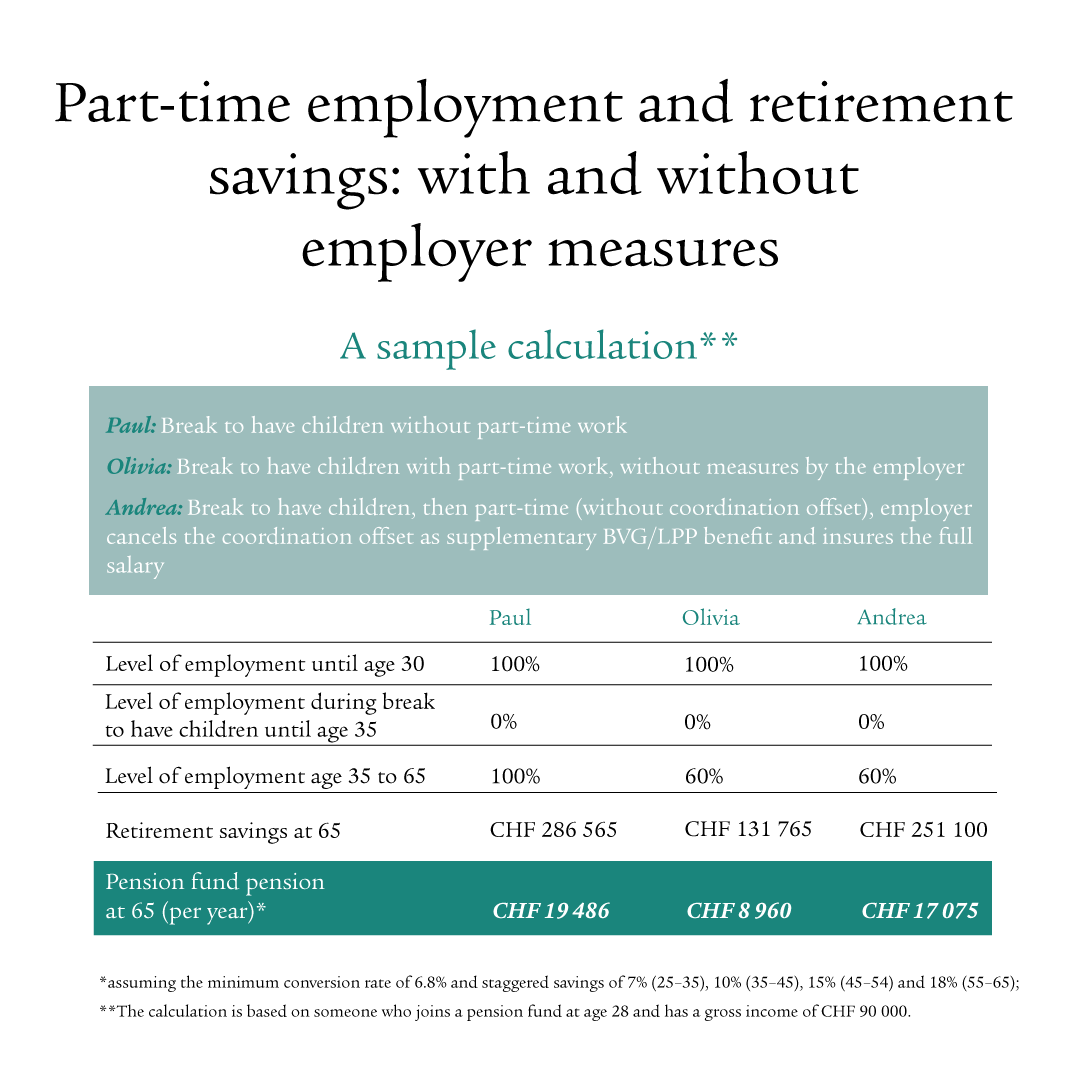
Employers can offer further supplementary benefits. Read the guide entitled “How to make the most of BVG/LPP supplementary benefits”. Employees can also save more for their retirement with pillars 3a and 3b or a voluntary 2nd pillar purchase.
Incorporate employees’ needs
Before introducing flexible working models, you should know your employees’ needs. Determine whether employees actually want an extra day off (four-day week) or whether they would prefer to be able to work from home.
You should also review separate solutions for each team. Example for a carpentry workshop: while working from home or a workation is more suitable for office workers, a four-day week is also feasible for manual employees.
If you are unsure about the models, you can trial various models for a certain period of time. Get your employees on board early in order to find the best solution together.
Clear communication
Ensure that the measures are communicated in an understandable manner to your employees. This will enable them to understand the benefits they stand to gain. And before rollout, prepare a clear concept for how the individual phases will work. This includes, amongst other things, work scheduling, adapted time tracking and clear guidelines.
In addition, do not just communicate the measures internally, but also use flexible working models as part of your employer branding externally in order to appear more attractive as an employer. For example, it is important that you mention the models as a benefit in your job advertisements. In some cases, a media release might even be an option.
FAQs
With flexible working models, companies offer their employees opportunities to organise their working hours or locations according to their needs. This facilitates a better work-life balance.
Common examples in terms of flexible working hours are flexitime, a four-day week and job sharing. In terms of workplaces, it is possible, for example, to work from home or remotely.
With flexible workplace design, companies allow their employees (partly) to choose where they work themselves. This ranges from shared desks at the office and working from home to remote work, for example abroad.
- Impeded accessibility: There will be days on which individual employees cannot be contacted. Although this is not necessarily a disadvantage, it does require planning and coordination within the team.
- No clear boundaries between work and leisure: Employees often work outside office hours. This may prove a burden.
- Increased administrative outlay: Companies will have to change time tracking and in some cases structure it individually.